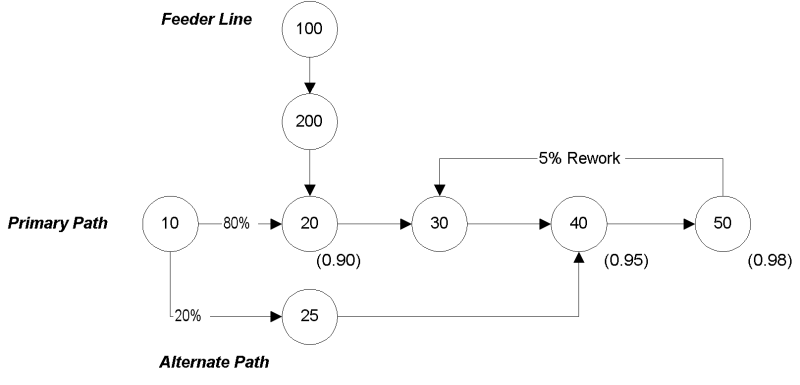
The system will calculate the cumulative yield, reverse cumulative yield and net planning percent for each process and line operation. This information is used in Mixed Model Map Workbench calculations and kanban planning. The following diagram displays an illustration of the setup used in the example calculations.
In the above example, the primary path is operation 10 through 50. The numbers in parentheses are the yields for the operation number above it, as entered by the user. The percentages on the network paths represent the network percent assigned to each path. Blank paths assume 100% network percentages. (The incoming network percentage for the first operation and the outgoing network percentage for the last operation are always 100%.)
Note: Any alternate path must skip at least one operation (or process) on the main line for the yield and planning percent calculations to work properly.
Net Planning Percent
The system calculates the net planning percent by using the following formula.
N c = S (Pp * I c) + Sr (Io*Wo),
where
N = Net Planning Percent, in decimal format
S = sum over all paths
P = Planning Percent = (Pp * I c) (system calculated - not displayed)
Note: Planning percent for the first operation is always 100%.
I = Incoming Network Percent, in decimal format (from Routing Network)
Note: Incoming network percent for the first operation is always 100%.
p = previous operation
c = current operation
Sr = Sum over all rework loops within which is this operation
W = Rework percent (from the routing network)
o = Operation originating the rework
In other words, the system calculates the net planning percent by taking the sum over all primary and alternate paths of the product of the network percentages along that path, then adds a rework calculation if the operation is within the rework loop. The planning percent and incoming network percent for the first operation on the primary path are always 1. The planning percent for the Feeder line is always the same as the operation to which they feed.
The rework calculation is equal to the planning percent of the rework's originating operation, times the rework percent coming from that operation (in this example, OP50 is the originating operation for the rework, and its planning percent is 100%, and the rework loop is 5%. Therefore, the rework calc is 100%*5% = 5%. This value is added to all operations in the loop (30, 40 and 50).
The number of paths is determined by working backwards along primary and alternate paths from the end of the line (so in the example, operations 30, 40 and 50, each have two paths due to the alternate path).
Caution: If a rework loop returns to an operation that is also fed by a feeder line, the feeder line will include the rework loop percent in the Net Planing Percent.
| Operation | Incoming Network Percent | Planning % Calculation + Rework Calculation | Net Planning Percent |
|---|---|---|---|
| 10 | 100 | 1 * 1 + 0 | 1 |
| 20 | 80 | 1* 0.80 + 0 | 0.84 |
| 25 | 20 | 1* 0.20 + 0 | 0.20 |
| 30 | 100 | (1 * 0.80 * 1) + 1 *.05 | 1.05 |
| 40 | 100 | (1 * 0.80 * 1 * 1 + 1 * 0.20 * 1) +1 *.05 | 1.05 |
| 50 | 100 | (1 * 0.80 * 1 * 1 * 1 + 1 * 0.20 * 1 * 1) + 1 *.05 | |
| 100 | feeder - uses network% from 20 | 0.80 + 0 | 0.80 |
| 200 | feeder - uses network% from 20 | 0.80 + 0 | 0.80 |
Cumulative Yield
The cumulative yield for the first operation along the main line and any feeder lines is the yield entered by the user. The system calculates the cumulative yield for all other operations using the following formula:
C c = Y c * S (Cp * Pp * I c / Pc),
where
C = Cumulative Yield
Y = Yield (User entered)
S = sum of all paths
P = Planning Percent, in decimal format (P = Net Planning% - Rework Calc)
I = Incoming Network Percent, in decimal format (from Routing Network)
p = previous operation
c = current operation
For example, operation 20 in the example above:
C20 = Y20 * S(C10 * P10 * I20 / P20) = 0.90 * (1 *1 * 0.8 / 0.8) = 0.9
Starting from the front of the line, the results for the example are:
| Operation | Yield Entered | Incoming Network % | Plan % | Cumulative Yield Calculation | Cumulative Yield |
|---|---|---|---|---|---|
| 10 | null | 100 | 1 | 1 | = 1 |
| 20 | 0.90 | 80 | 0.8 | 0.90 * (1 * 1 * 0.8 / 0.8) | = 0.90 |
| 25 | null | 20 | 0.2 | 1 * (1 * 1 * 0.2 / 0.2) | = 1 |
| 30 | null | 100 | 0.8 | 1 * (0.9 * 0.8 * 1 / 0.8) | = 0.9 |
| 40 | 0.95 | 100 | 1 | 0.95 * (0.9 * 0.8 * 1 / 1) + (1 * 0.2 * 1 / 1) | = 0.874 |
| 50 | 0.98 | 100 | 1 | 0.98 * (0.874 * 1 * 1 / 1) | = 0.8565 |
| 100 | null | 100 | 1 | 1 | = 1 |
| 200 | null | 100 | 1 | 1 * (1 * 1 * 1 / 1) | = 1 |
Reverse Cumulative Yield
The reverse cumulative yield for the last operation along the main line is the yield entered by the user. The system calculates the reverse cumulative yield for all other operations using the following formula:
R c = Y c * S (O c * R n),
where
R = Reverse Cumulative Yield
Y = Yield (user entered)
O = Outgoing Network Percent, in decimal format (from Routing Network)
Note: Outgoing network percent for the first operation is 100%.
n = next operation
c = current operation
S = the sum over all outgoing paths
For example, operation 20 in the example above:
R20 = Y20 * S(O 20 * R 30) = 0.90 * (1 * 0.931) = 0.8379
| Operation | Yield | Outgoing Network % | Reverse Cumulative Yield Calculation | Reverse Cumulative Yield |
|---|---|---|---|---|
| 50 | 0.98 | 100 | 0.98 | |
| 40 | 0.95 | 100 | 0.95 * (1 * 0.98) | 0.98 |
| 30 | null | 100 | 1 * (1 * 0.931) | 0.931 |
| 20 | 0.9 | 100 | 0.9 * (1* 0.931) | 0.8379 |
| 25 | null | 100 | 1 * (1 * 0.931) | 0.931 |
| 10 | null | 80 and 20 | 1 * [(0.8 * 0.8379) + (0.2 * 0.931)] | 0.85652 |
| 200 | null | 100 | 1 * (1 * 0.838) | 0.8379 |
| 100 | null | 100 | 1 * (1 * 0.838) | 0.8379 |