Each message enabled for a Trading Partner includes a protocol type (also known as communication method) that identifies the message delivery method. The associated correlation ID is determined internally and is associated with the message enqueued onto the agent (queue). Listeners defined for the agent will dequeue messages based on the correlation ID defined for it. For example, Oracle Transport Agent will only dequeue messages with a correlation ID of OXTA.
The following table shows the Protocol Type, Correlation ID, and Message System.
| Protocol Type | Correlation ID | Message System |
|---|---|---|
| NONE | N/A | Message disabled |
| HTTP, HTTP-OXTA, HTTPS, HTTPS-OXTA, SMTP | OXTA | Oracle Transport Agent without attachments |
| OTAH-ATCH, OTAHS-ATCH | OXTA | Oracle Transport Agent with attachment using standard OTA envelope |
| HTTP-ATCH, HTTPS-ATCH | OXTA | Oracle Transport Agent with attachment and no OTA envelope |
| ITG03 | ITG03 | Oracle iProcurement Connector, must be enabled |
| IAS | IAS | Oracle Application Server, must be enabled |
| HTTP-WM, HTTPS-WM | WebMethods | Third party system available only to users of Oracle Exchange |
| SOAP | N/A | Web Service Agent |
| JMS | N/A | JMS Provider |
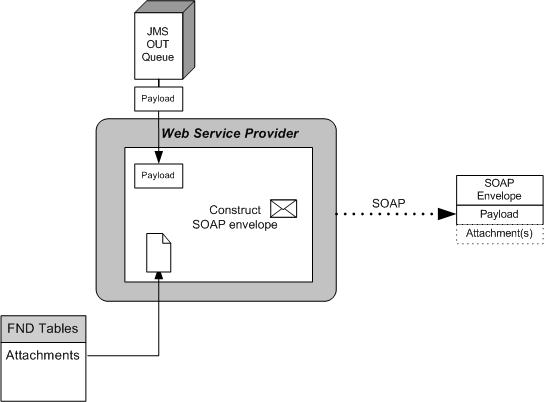
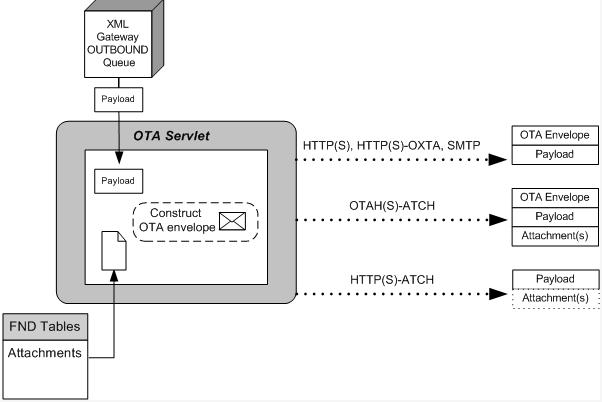
The following graphics display the construction for each protocol type:
For protocol types HTTP(S) and HTTP(S)-OXTA, the OTA servlet dequeues the message payload and constructs the OTA envelope.
For protocol type OTAH(S)-ATCH, the OTA servlet dequeues the message payload, constructs the OTA envelope, and assembles the attachment(s).
For protocol type HTTP(S)-ATCH, the OTA servlet dequeues the message payload and assembles any attachments, if present.
For protocol type SOAP, the Web Services provider dequeues the message payload, assembles any attachments, and constructs the SOAP envelope.