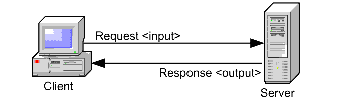
There are two major message exchange patterns - a request-response pattern, and a one-way (request - only) pattern.
Request - Response Message Pattern
The request - response message exchange pattern is where a client asks a service provider a question and then receives the answer to the question. The answer may come in the form of a fault or exception. Both the request and the response are independent messages. The request - response pattern is often implemented using synchronous operations for simple operations. For longer running operations, asynchronous (with message correlation) is often chosen.
Request - Response Message Pattern
A synchronous operation is one that waits for a response before continuing on. This forces operations to occur in a serial order. It is often said that an operation, "blocks" or waits for a response. Many online banking tasks are programmed in request/response mode.
For example, a request for an account balance is executed as follows:
A customer (the client) sends a request for an account balance to the Account Record Storage System (the server).
The Account Record Storage System (the server) sends a reply to the customer (the client), specifying the dollar amount in the designated account.
An asynchronous operation is one that does not wait for a response before continuing on. This allows operations to occur in parallel. Thus, the operation does not, "block" or wait for the response. Asynchronous operations let clients continue to perform their work while waiting for responses that may be delayed. This is accomplished by returning an asynchronous handle that runs a thread in the background, allowing the client to continue execution until the response is ready.
Attention: In this release, the Web service invocation framework only supports Synchronous Request - Response message pattern and One - Way (Request Only) message pattern.
Request Only Message Pattern
The request only operation model includes one input element, which is the client's request to the server. No response is expected.
Request Only Message Pattern
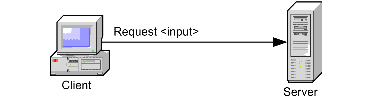
For example, client zip code locations send updated weather data to the service when local conditions change using the request only operation. The server updates the data but no response is sent back.