The U.S. Equal Employment Opportunity Commission (EEOC) defines an establishment as an economic unit, such as a factory, office, store, or mine, that produces goods or services. Typically, the establishment is at a single physical location and is engaged in predominantly one type of economic activity. For many EEO-related reports, you must organize employment data by establishment.
In Oracle HRMS, an establishment is a location, and you record establishment information in location EITs. For example, in the location EIT "EEO-1 Specific Data," you record the EEO-1 reporting name and unit number of the establishment. Using the Oracle HRMS generic hierarchies functionality, you can define a hierarchy of one or more establishments to represent your enterprise for reporting purposes. The establishment hierarchy is especially useful when you need to run reports for multiple establishments, as a single request can produce reports for multiple establishments. The establishment hierarchy you define is reusable: you can run various government-mandated reports, such as the EO Survey report, the EEO-1 reports, and the VETS-100 reports for the same establishment hierarchy.
In the Maintain Hierarchy Content page, you enter a name for your establishment hierarchy, and select the hierarchy type "VETS, EEO, AAP, OSHA, Multi Work Sites." For this hierarchy type, you select an organization with the classification parent entity as the top node in the hierarchy. You record some of the data required by U.S. government reports against the organization that is the parent entity. For example, you specify default data for establishments in the hierarchy in the EEO-1/VETS Establishment Data record of the parent entity.
To define your establishment hierarchy, you identify child nodes of the parent entity node. Immediate child nodes of the parent entity are establishment nodes. If all employees in your enterprise work from a single establishment, you define an establishment hierarchy with one parent entity and one establishment node. Alternatively, if your employees work from multiple establishments, you define multiple establishment nodes as child nodes of the parent entity. In a multi-establishment hierarchy, you identify one of the establishments as the headquarters establishment by updating the location EIT "EEO-1/VETS Generic Data."
If any establishment in your hierarchy comprises more than one location, you define location nodes as child nodes of the establishment node. For example, you may group multiple small locations under a single establishment in your enterprise. When you run a report for the hierarchy, information from the locations (such as employee assignments associated with the location) appears in the establishment report. However, this third level of nodes (the location level) is not usually required.
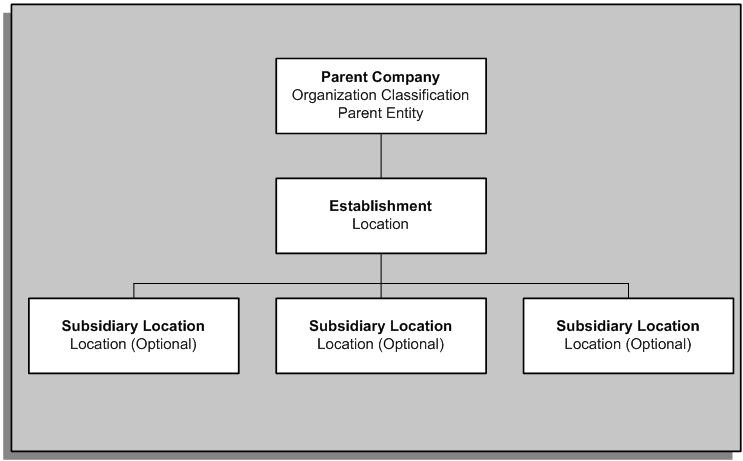
Single-Establishment Hierarchy
This figure shows an establishment hierarchy comprising a parent entity with one establishment node. This establishment has three subsidiary locations that are included in reports for the establishment.
Multi-Establishment Hierarchy
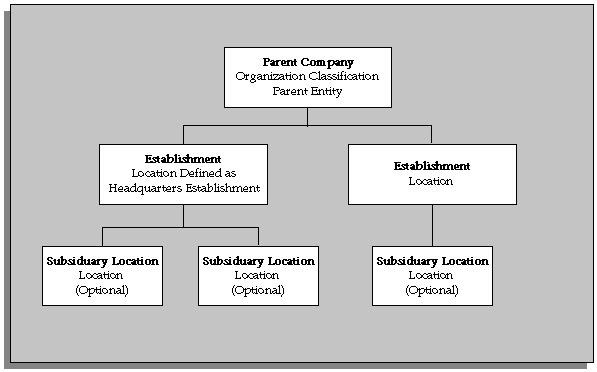
This figure shows an establishment hierarchy comprising a parent entity with two establishment nodes, one of which has been identified as the headquarters establishment. Both establishments have subsidiary locations.
This hierarchy of node types, where location is a child node of the establishment node, and the establishment node is a child node of the parent entity, is enforced by the hierarchy type "Vets, EEO, AAP, OSHA, Multi Work Sites."
In most cases, there is a one-to-one relationship between an establishment and a location. In some cases, there are many locations to one establishment. You can also associate a single location with multiple establishments. If different subsidiary companies of your enterprise (for example, a sales company and a maintenance company) that you want to report on separately are based at the same physical location, you can create multiple location records with identical address data but different establishment information in the location EITs. You include these establishments in the hierarchy in the usual way so that they appear as separate establishment nodes in the establishment hierarchy.