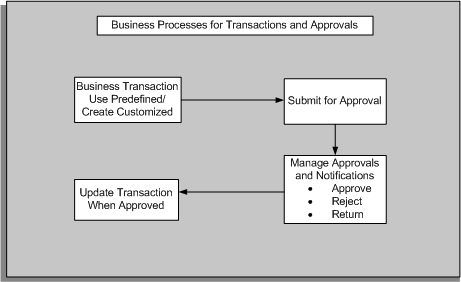
The purpose of Oracle Approvals Management (AME) is to define approval rules that determine the approval processes for Oracle applications. The following graphic illustrates the typical approval process used in an organization.
An approval rule is a business rule that helps determine a transaction's approval process. Rules are constructed from conditions and actions. For example an approval rule can be as follows:
If the transaction's total cost is less than 1,000 USD, and the transaction is for travel expenses, then get approvals from the immediate supervisor of the person submitting the transaction.
The following graphic identifies the components of the approval rule:
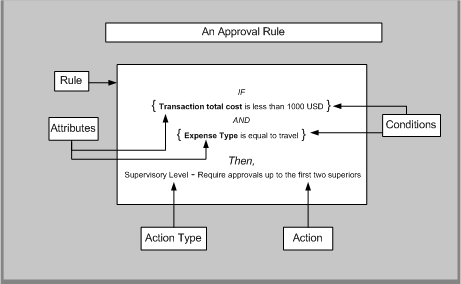
The approval rule's if part consists of zero or more conditions, and its then part consists of one or more actions. A condition consists of a business variable (in AME, an attribute) and a set of attribute values, any one of which makes the condition true. An action tells AME to modify a transaction's approval process in some fashion. The conditions in the sample rule in the graphic refer to two attributes: the transaction's total cost, and the transaction's purpose. The sample rule's action tells AME to add the requestor's supervisor to the transaction's approver list.
AME enables you to define rules that express a wide variety of approval rules. For example, rules that:
Require subject-matter-expert approval
Require managerial approval
Create exceptions for rules requiring managerial approval
Substitute one approver for another in special cases
Revoke a manager's signing authority in special cases
Grant a manager extra signing authority in special cases
Generate a production that assigns a value to a variable name such as the value digital certificate to the variable name eSignature.
Send for-your-information notifications.
You can prioritize the approval rules. This enables you to apply rules of sufficient priority to any given transaction.
An application that uses AME to govern its transactions' approval processes is termed an integrating application. An integrating application may divide its transactions into several categories where each category requires a distinct set of approval rules. Each set of rules is called a transaction type. Different transaction types can use the same attribute name to represent values that are calculated in different ways or fetched from different places. This allows several transaction types to share approval rules (thereby implementing a uniform approval policy across multiple transaction types). A rule use occurs when a transaction type uses a particular rule for a given time period, optionally at a given priority level.
Transaction Deviations
At the time of transaction approval, deviations such as addition of adhoc approvers or deletion of approvers can occur. It is possible to record these transaction deviations by setting the Record Approval Deviations configuration variable to Yes at transaction type level, and running the Approvals Deviations Report after the approval of a transaction. The report displays transaction deviations to the generated approver list.
AME generates an approver list based on the rules setup according to the business requirements. At the time of transaction approval, deviations such as addition of adhoc approvers or deletion of approvers can occur. Any such change to the generated approver list is a deviation. It is possible to record these transaction deviations by setting the Record Approval Deviations configuration variable to Yes at the corresponding transaction type level, and running the Approvals Deviations Report after the approval of a transaction. You can track the deviations by running the Approvals Deviations Report. This report displays the deviations between specified dates.