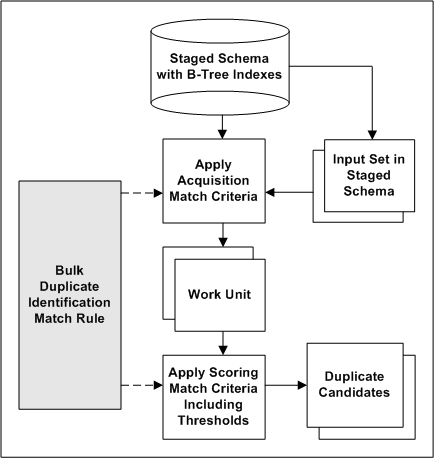
This diagram describes the bulk duplicate identification process, involving match rules with the Bulk Duplicate Identification purpose.
The staged schema stores the transformed TCA Registry attribute values for comparison in the matching process. The included attributes and the transformations applied to each are defined in the Define Attributes and Transformations page.
Also defined are the attribute and transformation combinations to be used for bulk duplicate identification. The staged schema includes B-Tree indexes only for the transformed attributes marked for bulk duplicate identification.
A duplicate identification process is started, either for a subset of records in the TCA Registry or for the entire Registry. The transformed version of that set of input records is already represented in the staged schema.
With the Bulk Duplicate Identification purpose, the match rule specified for the duplicate identification is applied to the staged schema, which is joined with the input set for bulk comparison.
Using the acquisition criteria in the match rule, each record in the input set is compared to all other records in the same staged table.
For example, an acquisition criterion is the D-U-N-S Number attribute with the Exact transformation. All D-U-N-S Numbers, as transformed by the Exact transformation, would be compared against one another.
Matched acquisition attribute values determine the most relevant subset of records from the staged schema to form the work unit.
Using the scoring criteria in the match rule, each record in the work unit is compared to all other work unit records in the same staged table.
A score is calculated for each record in the work unit, and scores for all entities are added together for determining duplicate parties.
The score of each work unit record is compared against the match and automatic merge thresholds defined in the match rule.
Records with scores above the match threshold are selected as potential duplicates.
Records with scores that also exceed the Automerge threshold are automatically merged, if Automerge is implemented and the match rule is designated for use with Automerge.
