After defining one or more Business Groups for your enterprise, you set up one or more Government Reporting Entities (GREs) within each Business Group. The GRE is the organization that federal, state and local governments recognize as the employer who:
Issues pay to employees.
Withholds taxes from employees' pay and is liable for employer taxes and tax reporting.
Provides other government-mandated reporting, such as EEO-1, OSHA, and New Hire reports.
Each GRE has a unique 9-digit number (sometimes called the employer identification number or taxpayer identification number) issued by the IRS. Your enterprise may have just one such number, in which case your Business Group and GRE are the same organization.
Large enterprises may include a number of different divisions or companies each with its own identification number from the IRS, in which case you set up a GRE for each. You can associate several GREs together as a Tax Group, for which one of the GREs can serve as the common paymaster.
Because of its pay, tax and reporting role, a GRE must contain the following information entered by you:
Basic rules affecting calculation of federal, state and local taxes, and information for tax reporting.
Information required for labelling NACHA tapes used to pay employees by direct deposit into their bank accounts.
Information for submission of government mandated reporting on matters such as employees' work-related injuries, equal employment opportunities, and obligations to pay child support.
Attention: The GRE in the Oracle HRMS products is the same organization as the Legal Entity that appears in the Oracle Financials products, holding the taxpayer identification number. For this reason, the GRE may appear as GRE/Legal Entity on pick lists.
Enterprises using Oracle HRMS and Oracle Financials products should define only one GRE/Legal Entity to represent each employer organization with a unique IRS identification number.
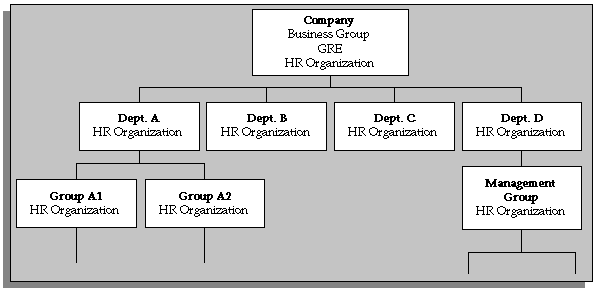
Enterprises with only one identification number from the IRS need only one GRE in which to place all employees. In Oracle HRMS, the Business Group and the GRE are the same organization. Appearing below is an example organization chart for a Business Group with one GRE.
Single Company Business Group/GRE
In a company like this, some employees can have assignments to the Business Group organization itself. Most have an assignment to one of the various HR Organizations subordinate to the Business Group. All employees belong to the same GRE, which pays them, withholds their taxes, and provides reports on various matters concerning them to government agencies.
For large enterprises that include several different employers with their own IRS identification numbers, all the employees in each company may be paid by that company, and hence all require an assignment to a GRE that coincides with their company. In this case you set up within the Business Group, a GRE for each separate employer.
In enterprises like this, all employees assigned to an HR Organization within a company have an assignment to the same GRE, and conversely, all employees in a given GRE belong to the same company.
GREs Coincident with Companies
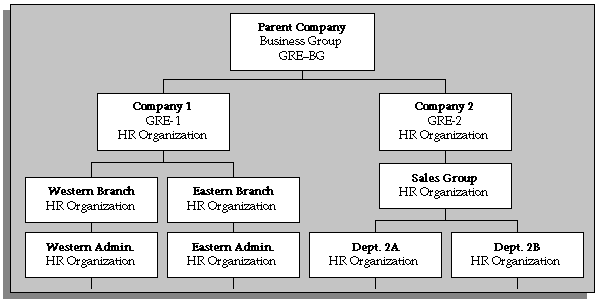
In other large enterprises, the GREs responsible for paying groups of employees are not the same as the companies within the Business Group, which may be organized, for example, according to the particular types of work or projects they undertake. The figure above still reflects the structure of the companies in this type of enterprise. But the GREs representing the employing organizations that pay employees have a separate structure that is independent of the companies, as in the figure below.
GREs Independent of Companies
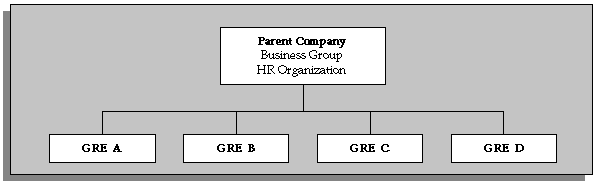
In this type of enterprise, employees assigned to a particular GRE can have a work assignment to any of the different companies constituting the enterprise, and a particular company can include employees assigned to several different GREs.
In enterprises like this, employees are clear about which company they are working in, but may be unaware of their membership in a separate GRE. Because the functions of GREs relate to payroll administration and governmental reporting, they have little direct impact on employees' daily lives at work.
Business Groups with multiple GREs often associate some GREs together in a Tax Group with a common paymaster.
Enterprises with multiple GREs can place certain GREs together in tax groups. The tax group takes the name you give it.
Attention: The Tax Group name must be consistent in spelling and case for all GREs to be included. For example, "My Tax Group" is not the same as "my tax group."
When multiple GREs are included in a tax group, the taxable limits for FUTA and SS are maintained at a Tax Group Level.
Using tax groups allows employers to give employees moving within GREs credit towards their Social Security, and Federal Unemployment Tax Act (FUTA) taxes.
At the same time that you enter federal tax rules for a GRE, you can place the GRE in a Tax Group.