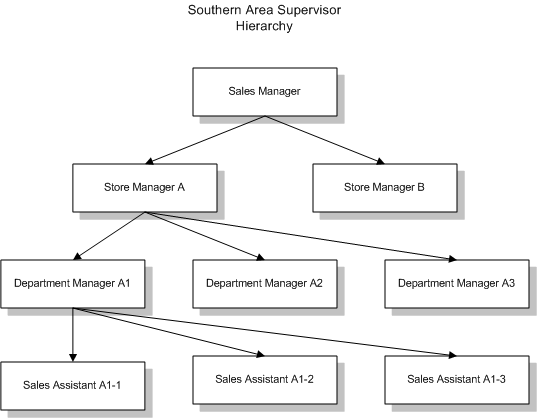
The HR Professional identifies the population of a Performance Management Plan (PMP) by selecting part or all of a hierarchy structure. For example, all workers in an organization hierarchy or all workers in two levels of a five-level supervisor hierarchy could be the members of a particular PMP. The following figure shows an example supervisor hierarchy whose workers belong to the PMP Southern Area Sales 2008.
To allocate the enterprise objectives in some form to all enterprise workers, you can use the cascading-objectives process. The top manager in the plan hierarchy (the sales manager, in our example), prompted by the PMP task Cascade or Set Objectives, begins the process by setting his or her own objectives using Employee Self-Service. Typically, the manager bases these objectives on the enterprise objectives. In this example, the sales manager has the following objectives:
| Objective | Target | Unit of Measure | Type |
|---|---|---|---|
| Increase sales revenue | 500,000 | USD | Minimum |
| Develop customer awareness | N/A | N/A | N/A |
To cascade these objectives to the store managers, the sales manager can:
Allocate them to the store managers and adjust the targets, if appropriate. For example, the sales manager can allocate the objective to increase sales revenue to both store managers. For store manager A, the target is 275,000.00 USD, and for store manager B, the target is 300,000.00 USD.
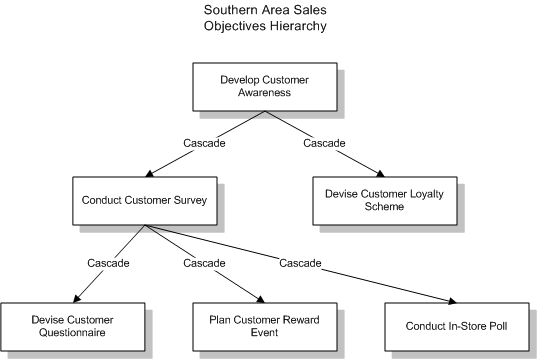
Create new objectives for either or both store managers. For example, to cascade the objective to develop customer awareness, the sales manager can create the new objective Conduct Customer Survey for store manager A and Devise Customer Loyalty Scheme for store manager B.
The store managers repeat this process for their department managers, who repeat it in turn for their sales assistants. For example, store manager A can cascade the objective Conduct Customer Survey to the three department managers by defining three new objectives:
Devise customer questionnaire.
Plan customer reward event.
Conduct in-store poll.
Once the store manager has set these supporting objectives for the department managers, they can, in turn, cascade their objectives to the sales assistants who report to them.
The effect of the cascading process is to define a hierarchy of objectives, where each level comprises supporting objectives for the objectives at the next level.
The following figure shows the objectives hierarchy from our example:
The supporting objectives are automatically aligned with the objectives above them in the hierarchy.
Note that, for each worker in the hierarchy, the cascading process is just one way of setting objectives. Managers can also set nonsupporting objectives for workers, and workers can set their own objectives. You can use all methods in a single PMP.
In the PMP, the HR Professional can select either cascading or parallel objective setting. In a cascading process, managers start objective setting; in a parallel process, workers start objective setting.
The following figure summarizes the flow of control between managers and workers in a cascading process. The process starts with the manager task Cascade or Set Objectives.
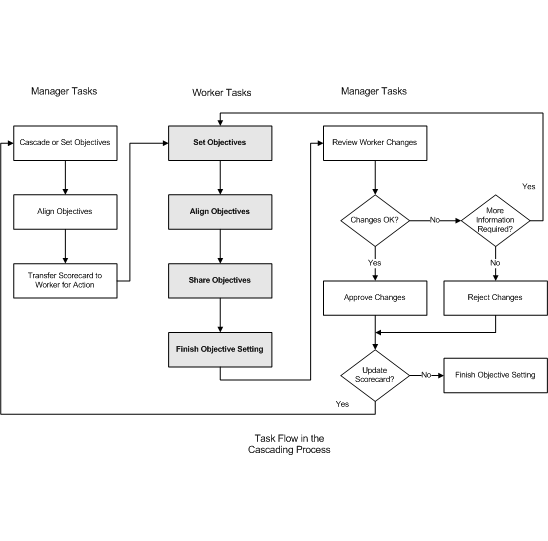
For information about the tasks shown in this figure, see Manager Performance-Management Tasks and Worker Performance-Management Tasks
For information about the parallel process, see Setting Objectives in Parallel