You can build hierarchies of objectives, with objectives at lower levels in the hierarchies supporting those immediately above them. Objectives at lower levels, known as supporting objectives, are said to be aligned with those objectives that they support. Supporting objectives:
Can be identical to the objectives that they support, perhaps with different targets, or they can be completely different
Do not have to have the same measurement style as the objectives that they support
Not all objectives need to belong to an objectives hierarchy. Typically, personal objectives remain outside hierarchies. You can delete objectives that belong to objectives hierarchies without causing errors.
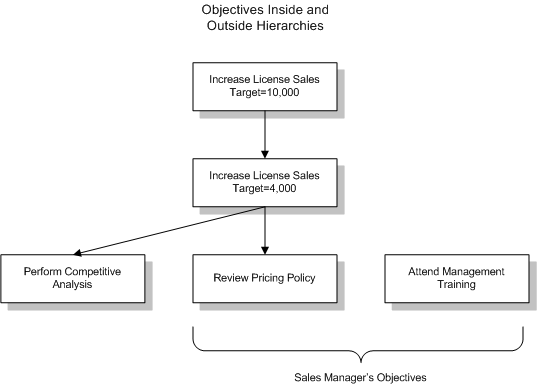
The following figure shows objectives inside and outside a hierarchy:
In this figure, the objectives at the first two levels of the hierarchy are identical; at the third level, objectives are different from the objective that they support. The sales manager has two objectives, but only one, Review Pricing Policy, aligned with Increase License Sales, belongs to an objectives hierarchy. The sales manager is unaware of the objective Perform Competitive Analysis.
When managers cascade objectives to workers who report to them, they create supporting objectives that are automatically aligned with the cascaded objective. Workers and managers can also create relationships between objectives manually. Before you can align an objective with a different objective:
The HR Professional or manager must have enabled sharing and alignment in the Performance Management Plan (PMP).
The objective's owner must have shared the objective with you and permitted alignment.
You can share any of your objectives with other members of the PMP. If you allow others to view an objective, they can view its detail but not align their objectives with it. If you allow others both to view and to align, they can define supporting objectives for the shared objective.
For example, if you share the objective Improve Supplier Relationships with four coworkers, each coworker can define a supporting objective and align it with your objective. You can view those supporting objectives only if security permissions give you access to your coworkers' personal scorecards.
Managers typically share objectives by cascading them, in which case sharing and alignment are automatic. Alternatively, managers can share objectives if they use Employee Self Service to perform the Share Objectives task.
When you align an objective, you define a relationship between your objective and an objective that another member of the PMP has shared with you. The Align Objectives page, accessed from the Align Objectives task, displays a list of people who have shared objectives with you; you can view details of each shared objective. Note that you can align an objective with only one other objective.
When sharing and alignment are enabled, managers receive the Align Objectives task. This optional task enables you to align the objectives of workers who report to you with your own objectives. In the Alignment column, you can align each objective in a worker's personal scorecard with one of your own objectives. As you own these objectives, you do not have to share them with the worker first. You may want to perform Align Worker Objectives when workers have initiated the objective-setting process and have no access to shared objectives.