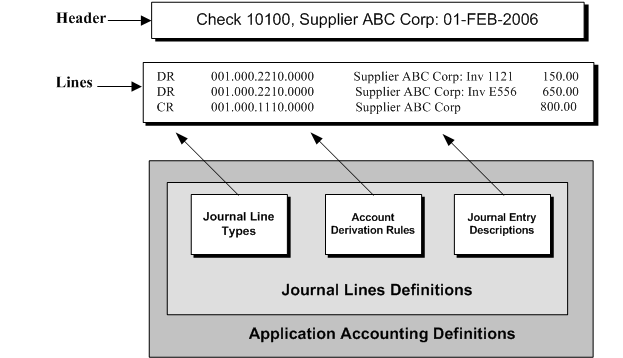
The AMB enables you to create and modify subledger journal line setups and application accounting definitions. These definitions define the journal entries that enable an organization to meet specific fiscal, regulatory, and analytical requirements. These definitions are then grouped into subledger accounting methods and assigned collectively to a ledger.
By using the AMB, you can define the way subledger transactions are accounted. The AMB includes the following features that are discussed in this chapter:
Accounting options that determine different characteristics of the journal entry
Descriptions that appear on the subledger journal header and lines which provide additional information about the journal entry
For example, a subledger journal entry created for a Payables invoice can show the supplier name and invoice number.
Account derivation rules to construct the accounts for a subledger journal entry line
Users define various rules in the AMB to determine how a journal entry account is derived. Users can derive accounts segment by segment or as a complete Accounting Flexfield.
Conditions that determine when subledger journal entry accounts and lines are created
Some accounts can be used to create a journal entry only in certain circumstances. For example, an asset account can only be used when the Assets flag for an invoice distribution is enabled through the Oracle Payables Invoices window.
The different elements of a subledger journal and their relationships to the AMB are displayed in the diagram below and explained in the subsequent text.
Elements of a Subledger Journal Entry
The AMB includes journal entry setup components to configure each of these elements:
Journal Line Types: Control journal entry line options such as balance type, side, and summarization
Journal Entry Descriptions: Control the description for the journal entry headers and lines
Account Derivation Rules: Control the derivation of Accounting Flexfield combinations for the journal entry lines
The journal entry setup components are associated with journal lines definitions that are attached to application accounting definitions. You can group detailed subledger accounting definitions for different kinds of transactions into consistent sets, each of which addresses different needs. While one application accounting definition can generate subledger journal entries to meet a particular set of requirements, another definition can be defined to satisfy completely different requirements.
To use application accounting definitions, they must be included in a subledger accounting method and then assigned to a ledger. Users can group accounting definitions from multiple products, such as Oracle Payables, Oracle Receivables, and Oracle Assets into a single accounting method. You can assign a subledger accounting method to multiple ledgers.
As an example of these groupings and assignments, consider a set of definitions set up to create accrual accounting for payables in the U.S. These definitions can be grouped into the U.S. Payables Accrual application accounting definition. Accrual accounting application accounting definitions for each application in the U.S., such as U.S. Payables Accrual and U.S. Receivables Accrual, can be grouped into the U.S. Accrual Subledger Accounting Method.
The relationship between the various AMB components are displayed in the diagram below and is described in the succeeding text.
Accounting Methods Builder Components
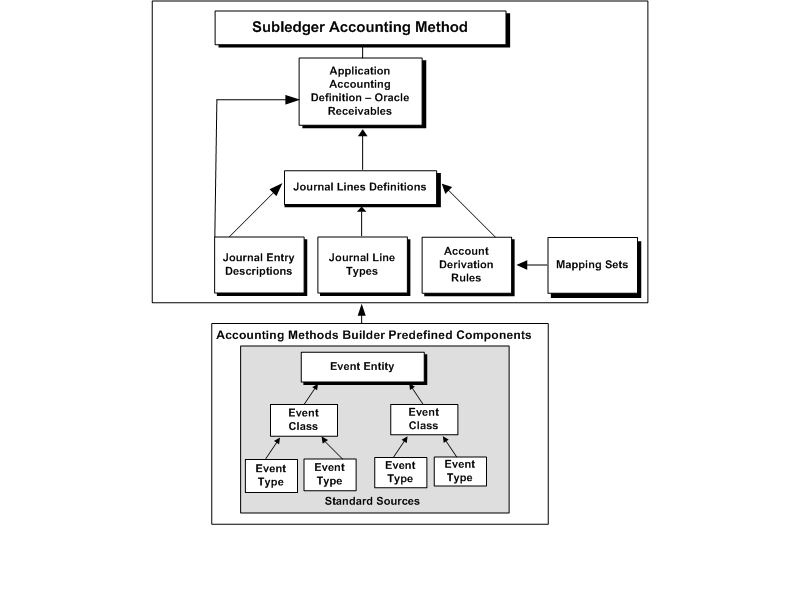
The above diagram shows how the AMB predefined components, standard sources, event entities, event classes, and event types, can be used to create journal entry descriptions, journal line types, account derivation rules, and mapping sets. The mapping sets are used in the setup of account derivation rules. The journal line types, account derivation rules, and journal entry descriptions are assigned to journal lines definitions. The journal lines definitions and optional journal entry descriptions for the journal headers, are assigned at the application accounting definition level. Application accounting definitions are grouped in a subledger accounting method.
Oracle Applications development provides startup application accounting definitions and at least one subledger accounting method for all products using Oracle Subledger Accounting. If users do not have any special accounting requirements, these startup definitions may meet their needs and the only required setup step is to assign subledger accounting methods to the ledger.
If users have specific accounting requirements that are not met by the startup definitions, they can copy and modify the seeded definitions or create new definitions.