Inter-project billing functionality in Oracle Projects handles inter-project billing project relationships and the billing of inter-project transactions. These features are described in detail on the following pages.
The section covers the following topics:
Inter-Project Billing Project Relationships
Overview of Processing Flow for Inter-Project Billing
Adjusting Inter-Project Billing Invoices
Inter-project billing generates internal invoices for costs incurred between two projects. During project setup, you define an inter-project billing relationship. This relationship enables you to invoice internally between the two projects, also called provider and receiver projects. (See definition of terms.)
Once the work has been performed, the provider project generates an Oracle Receivables invoice for expenses incurred. The receiver project receives this invoice as an Oracle Payables invoice during the AR invoice tieback process. The invoice, like any supplier invoice, is interfaced to Oracle Projects as cost on the receiver project.
Note: To use inter-project billing you must implement multi-organization setup even if only one operating unit is setup.
See also: Setting Up Inter-Project Billing: Oracle Projects Implementation Guide.
Enterprises face complex accounting and operational issues that result from complex work breakdown structures. Multiple organizations or departments may work together on a project, yet the customer wishes to receive only one bill. Parts of the work performed may be billed externally to a customer while other work may be billed internally to another project. These types of business needs require a way to capture multiple project costs into one project regardless of where or by whom the work is performed.
With inter-project billing, projects can be managed and controlled separately, and can bill both internally and externally. Using this model to define your work structure provides flexibility in managing your projects and consolidates costs for reporting purposes.
Consider the following examples:
Business Needs Example 1
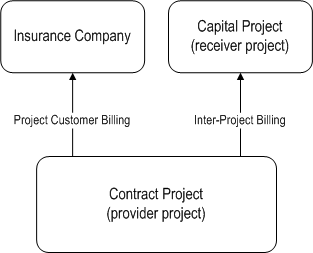
During an auto accident, a telephone pole owned by the local telephone company is knocked down. A contract project is set up to track the cost of the repair. These costs will be billed to an insurance company. While the repair is under way, the telephone company decides to replace the old transformer at the top of the downed pole. These costs will need to be capitalized and will be billed internally to a capital project. The contract project will bill the insurance company for repair work performed on the pole, and, using inter-project billing, will bill a receiver project for work performed on the transformer. The receiver project can exist at any organization level in the enterprise, regardless of operating unit or ledger.
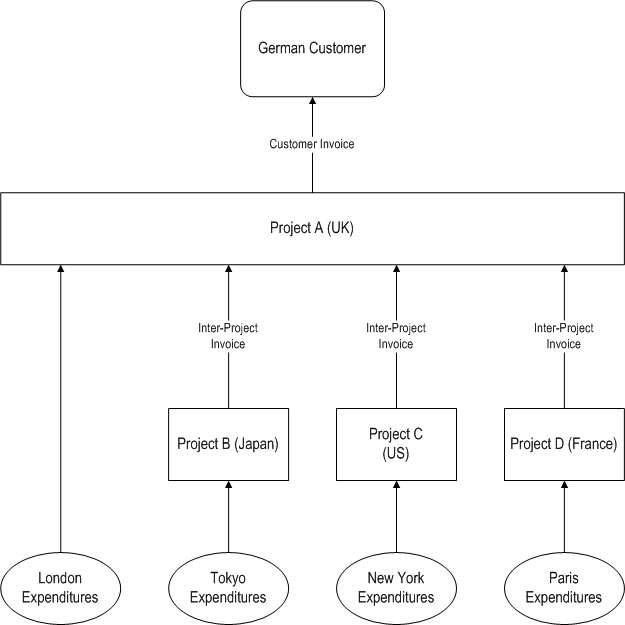
Company ABC is an advertising company with a multiple organization structure. The London operating unit, ABC's headquarters, received a contract from a German customer. The customer wants ABC to produce and air live shows in Paris, New York, and Tokyo to launch its new line of high-end women's apparel. ABC will plan and design the show using resources from the London operating unit. The Paris, New York, and Tokyo operating units are each responsible for the successful execution of these live shows with their local resources.
Using the structure shown above, the customer project is divided into several related contract projects. The London operating unit owns the primary customer project, or receiver project, and bills the external customer. The related projects, or provider projects, are subcontracted to their respective internal organizations and internally bill the London organization to recover their project costs.
